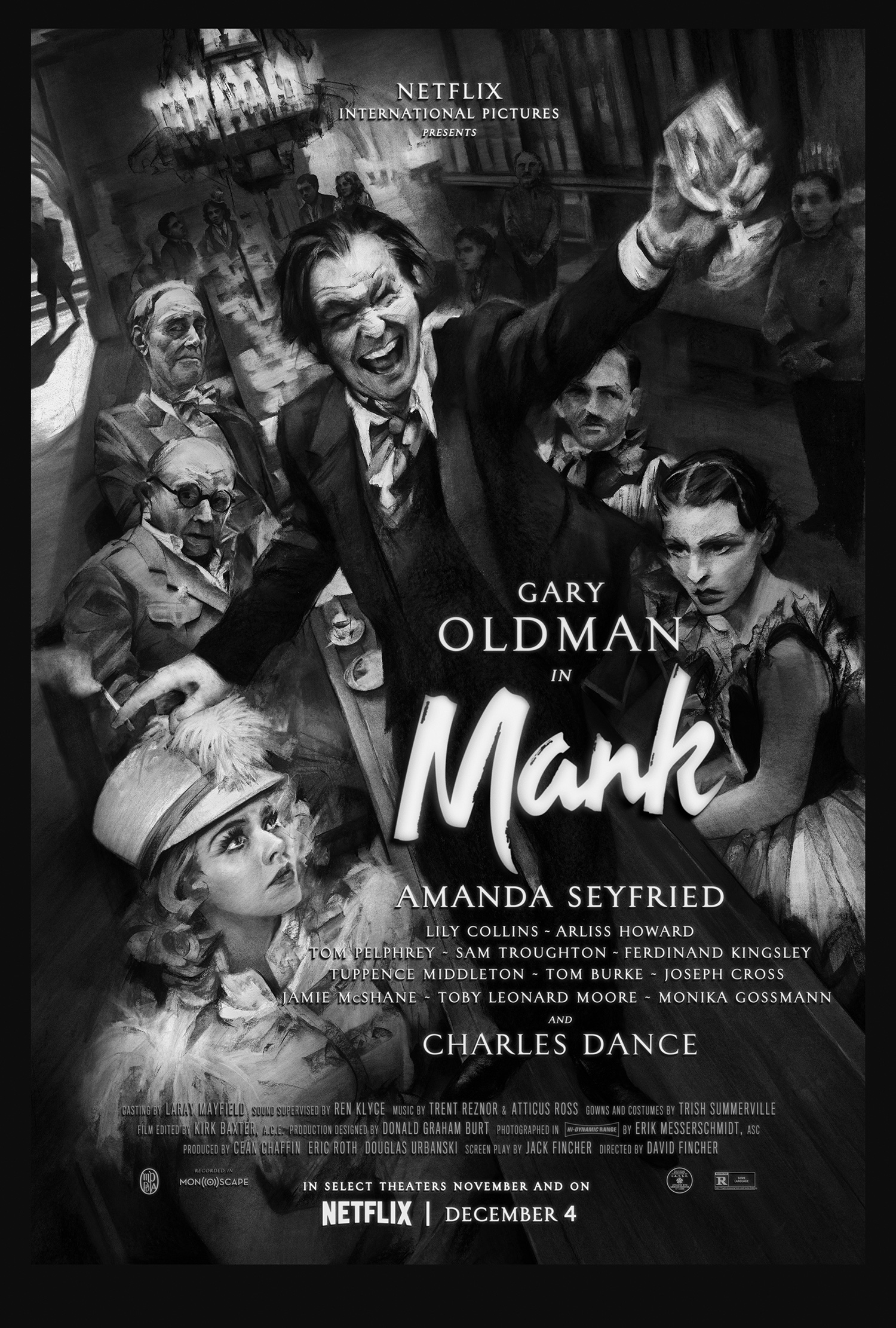
A Netflix Original Picture, Written by Jack Fincher, Directed by David Fincher.
‘1930s Hollywood is re-evaluated through the eyes of scathing wit and alcoholic screenwriter Herman J. Mankiewicz as he races to finish “Citizen Kane.’ David Fincher directs the film for Netflix, based upon the screenplay by his late father Jack Fincher. The film very much tells the story of the forgotten man of Citizen Kane (1941), Herman J. Mankiewicz, and also uses him as a gateway into looking at the film industry in the late 30s/early 40s, as well as the relationship of the film industry to politics.
Mank (2020) is meticulously moulded in every way, making it feel and look exactly like it was made in the early 40s, not just set at that time. This is a very deliberate decision from a director who never lets anything happen by accident. He wants this film to not just be an exploration of the golden era of Hollywood, but a recreation of it, and it is done superbly in every aspect. Fincher truly captures the magic of that time in Hollywood, the feeling of the movies being something truly special and the old Hollywood system creating that, whilst also very much exposing the abuse and hypocrisy that was at the heart of much of it, and still is today.
As a story about Herman J. Mankiewicz (aka Mank) specifically, and about his journey writing Citizen Kane, I don’t think the film is effective as it really could have been, and due to some narrative decisions, a lot of it comes off as quite cold and detached. We don’t really have enough of a chance to learn what a good man Mank was before we went off the deep end, and we don’t truly feel the struggle enough and the mistreatment he received around the time of writing Citizen Kane. When Mankiewicz is interacting with the real legendary figures from the time, whether its on film studio lots or at parties discussing the incredibly interesting politics of the time (something that really stood out to be about how it was integrated in here) is where the film is at its best and where the character himself is able to really shine.
As for the man behind Mank himself, Gary Oldman gives a reliably strong performance in the lead role. He is clearly drawing on his own past addiction problems when presenting Mank’s alcoholism and the impact it has on those around him, managing to avoid cliches and seem like a real person. Oldman is one of the most respected character actors around and he certainly does a solid and convincing job here, but he is at his absolute best when sharing the screen with Amanda Seyfried’s Marion, with the two of them sharing some really unexpected and great chemistry.
That brings me perfectly on to Amanda Seyfried as Marion Davies, as she steals the entire film in her supporting role. The likes of Lily Collins, Arliss Howard, Charles Dance, and Tom Burke (who makes for a superb Orson Welles but simply isn’t in the film enough to really register) all do some good work, but it is absolutely Seyfried who is the star. Every time she is on the screen, she lights it up with a movie star glows that comes straight from the golden ages of Hollywood, and her dazzling beauty, specifically her bright blonde hair and uniquely large eyes make her pop in the black and white and really dominate the frame. There’s a real charm to her Marion, a kindness and humour that blends perfectly to Mank’s more pessimistic outlook, and at times it makes you wish that Fincher had just decided to tell a Marion Davies biopic, because she had a fascinating story and was wronged by Hollywood (Mankiewicz included) and deserves her day in the sun.
David Fincher is undeniably one of the greatest filmmakers of the 21st century, and should already have won a best director Oscar by now. The way he assembles his crafts team to all work together to create something special here is very impressive, whether it’s the period accurate production and costume design, the engaging score, or the stunning black & white cinematography, Fincher is very much a conductor playing the band, and he is at the height of his powers. However, the film itself just doesn’t sit with you after watching the way many of his others did, and that is why I don’t think Oscar gold will come his way this year and that Mank will go down as a mid-level Fincher entry.
Overall, Mank is a technical marvel and is still one of the finest films of 2020, but with the expectations so high for Fincher’s return to feature films after six years away, it feels slightly flat after watching the film. All the ingredients were there, but in turning this into a story of Herman J. Mankiewicz specifically when he was writing Citizen Kane, the film gets stuck in the shadow of Welles’ masterpiece. Maybe Fincher can reunite with Seyfried and really wow audiences with a full feature biopic of Marion Davies.
Rating = 4/5
 Howe's World of Film and TV