Written and Directed By Christian Petzold.
‘Undine (Paula Beer) works as a historian lecturing on Berlin’s urban development. But when the man she loves leaves her, the ancient myth catches up with her. Undine has to kill the man who betrays her and return to the water.’ This is the basic premise of Undine, the latest film from director Christian Petzold, but if you didn’t know better going in, this could just strike you as a standard romance to start. In many ways, the film never truly addresses the mythical story that it is truly telling and just waits for the audience to catch up and look into it as much as they choose, as the love story at the heart of the film is enough to interest you.
I went in to the film without any idea at all what was in store, expecting a Petzold tragic romance with a modern-day Berlin backdrop, and the film starts out that way. She is summoned to a café near her work and we see her process the news that Johannes (Jacob Matschenz) is telling her, that they are going to break up. Her response is startling, telling him “if you leave me, you have to die”, which at first seems like a lover scorned but is actually much more. Despite her human appearance, Undine is at origin a water spirit, only able to take her human form by falling in love with a man — one who must remain faithful to her or else forfeit his life.’
Undine is at home in the human world, with a job she loves and a world she embraces, and despite being technically in unfamiliar territory, this is the world she wants to live in. As with many of Petzold’s heroine’s (although admittedly with a more-high concept spin), she wants to live a life free of oppression and tragedy, but she is unsure if destiny will catch up on her. Then, quite soon after her break up, she meets industrial swimmer Christoph, a kind and devoted man (Johannes may be man’s infidelity, Christoph is quite the opposite) and the two fall deeply in love. He is a diver, one who revels in bizarre and fantastical underwater creatures, although he has no idea how close he is to one. He even reminisces about having seen Undine’s name carved onto an ancient arch, deep in the lakes, and takes her to see it on a date (although she very clearly knows it is there and placed it there many years ago). As Johannes returns to the picture, the plot and drama really kicks in as everyone’s lives become at risk as Undine fights to save her love and her life. There are shock twists throughout and you are kept guessing right up until the end, never knowing who will survive and who will end up together. Can Undine truly escape her destiny?
On a technical level, the film is a real triumph. The cinematography is incredibly specific and unique, with visual flourishes mixing smoothly in against the backdrop of Berlin to provide that mix of mystical and yet real. The camera work is fast and really tracks with the characters, often making the audience feel that they are right there alongside them and tracking what is happening. The editing also buys into this and really effectively gives the film a flow that allows you to settle back and feel as though this is a story you are living as well.
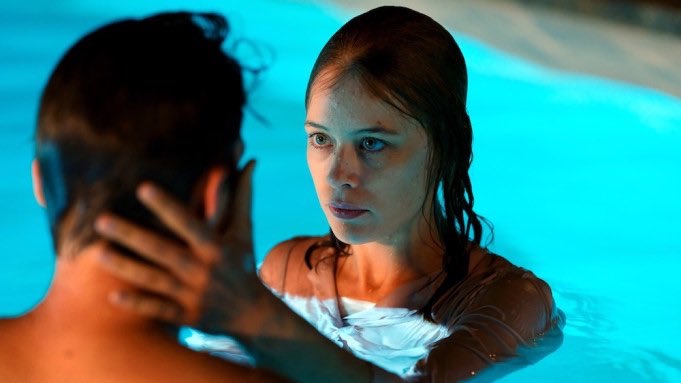
There are many memorable sequences for a variety of reasons, but from a purely visceral and visual stand point, I have identified two particularly sequences from the film. The first is when Undine and Christoph go on a diving date to see where her name was carved under the water, and it is the first time we (and Christoph) see her in her ‘natural’ environment, and she all of a sudden takes on a mermaid style magic around her, and both the audience and Christoph are unsure what we see in those split seconds, and it really takes your breath away. The second moment is from much later in the film, as Undine is increasingly determined and returns to the water again, this time to a swimming pool to kill someone she has to get rid of in order to save what she loves, and the way she stalks her prey is mesmerising and terrifying to watch, like a Siren luring in her victim.
This is not perfect, with the way Petzold reveals his true story and themes at times heavy handed and at times too subtle, never quite striking the ideal balance he wanted between gritty love story in modern day Berlin, and mystical folktale. There are multiple times throughout where you do question the dynamic, and almost feel like you’d much rather watch just one full version of the story that he has chosen to mix together into two. Petzold fails to effectively lay at the real basic rules that govern Undine and her kinds existence, and therefore up the stakes when we see her breaking them, as many of these gaps have to be filled in by the audience after the film.
The one thing that really sets the film apart is its remarkable lead performance from Paula Beer. She has a striking visual look, a beauty with large piercing eyes and a stunningly defined face, exactly what you would imagine of a mystical spirit in human form, and she is therefore perfect for the role. In her performance, she is completely engaging and entrancing from the first scene, and as the film develops, her range shows even more. She brings emotion, lust, pain, love, fear and hope to the role, and someone manages to successfully mix it all together, she has a couple of long monologues where she talks about the seemingly mundane (to some people) history of Berlin, and yet you cannot take your eyes off Beer, you are hanging on each word and it is almost transfixing. In a sane world she would be one of the major forces in the best actress race this awards season.
Overall, despite having some definite flaws, this is a film packed full of so much ambition and beauty, as well as having one of the finest performances of the year from Paula Beer. It mixes myths, tragedy, and the mysteries of the water to create a sweeping romance. With all this in mind, I think Undine is a film everyone should experience and try to take in because these are the kinds of daring projects that only the film industry can produce.
Rating = 3.5/5
 Howe's World of Film and TV